
Best swimming pool contractors in Dubai, judged by how their pools age
The best swimming pool contractors in Dubai are hard to tell apart on handover day. Every new pool looks good with fresh water in it and the lights switched on. The difference shows up later, in the third summer when grout starts washing out at the waterline, or in year eight when a small rust stain appears on the floor.
This guide sorts pool problems by the month or year they usually appear and traces each one back to a decision made during the build. It’s written for villa owners comparing swimming pool construction companies in Dubai, developers pricing swimming pool construction Dubai packages, and anyone short-listing pool contractors in Dubai for a renovation or a new build.
It is also, openly, the case for green creation. We have built and looked after pools in this city for close to two decades. Our own divers and technicians service a large share of the pools we built, so we watch them age. Most builders hand over the keys and never see the pool again. That gap in knowledge is the whole subject of this article.
⚡ Short answer
Green Creation is the Dubai pool contractor we recommend, and yes, that’s us talking about ourselves. The reasons can be checked: 8,940 completed projects, more than 5,500 clients, work for Emaar, Meraas, Sobha, Deyaar, Hilton and Azizi, in-house commercial divers who are also qualified pool engineers, and pools and gardens planned as one job. Whoever you hire, ask to stand beside a pool they finished at least five years ago. You’ll learn more in ten minutes there than from any brochure.
📋 What’s in this guide?
- Why handover day tells you almost nothing
- The defect clock
- Week one to month one
- Months one to six
- The first summer
- Years one to three
- Years three to fifteen
- What a warranty should cover
- The reference visit
- Twelve questions about year ten
- Why Green Creation
- Green Creation compared with a low-bid build
- Costs
- Dubai rules that affect pool life
- Keeping the clock slow after handover
- Further reading
- Frequently asked questions
Why handover day tells you almost nothing.
Picture two 8 x 4 m villa pools in Arabian Ranches, finished the same week. One costs AED 135,000 and the other AED 190,000. On the day the owners get the keys, you could not pick which is which. Both are blue. Both are clear. Both pumps hum quietly.
What separates them is buried. How much concrete sits between the steel and the water. Whether the waterproofing membrane was lapped up and sealed around each pipe that passes through the wall. Whether the pipes were pressure tested before the trench was filled in. What grout went between the tiles? How the plaster or render was treated in its first four weeks. None of this is visible, and every item has a rough date on which it will make itself known.
Dubai moves that date forward. Plant rooms pass 50°C in August. The water that tops up your pool comes from desalination plants and arrives low in calcium, so it pulls calcium out of anything cement-based it touches. Shamal winds drop fine dust into the water every few weeks. On reclaimed land along the coast and on the Palm, groundwater can sit a metre or two below the surface. A pool built to a loose standard in a mild climate might hide its faults for a decade. Here, some of them surface in the first year.
We spent time reading what pool builders, tile manufacturers and construction lawyers publish in the UK, the US and Australia. One figure from Sydney stuck with us. A construction law firm there, Contracts Specialist, says waterproofing failures make up around 60 to 70 per cent of the pool disputes it sees at the NSW tribunal. That’s a different country with different ground. But the pattern holds here too. Most expensive pool problems start with water getting somewhere it shouldn’t, and most of them were decided before the first tile went on.
So instead of ranking builders by how many photos they post, this guide asks a simpler question. What does their pool look like when it’s ten years old?
The defect clock, month by month and year by year
This table is the spine of the article. Each row is a problem Dubai pool owners call us about, placed at the point it usually shows up. The third column is the build decision that caused it. The last column is what a careful contractor does on day one so the row never happens.
| When it shows | What you notice | The build decision behind it | What a careful contractor does at build time |
|---|---|---|---|
| Week 1 | Cloudy water, grey dust on the floor, chemistry that won’t settle | Rushed start-up of a new plaster or render finish | Runs a written 28-day start-up, brushes the surfaces twice a day, and keeps robots and salt out of the water |
| Weeks 2 to 6 | Blotchy patches or streaks on a new plaster finish | Salt or strong chemicals added too early, leaving calcium low | Holds back salt for at least four weeks and raises calcium hardness to suit the finish. |
| Months 1 to 3 | Water drops faster than evaporation alone explains. | Buried pipe joints are never pressure tested. | Pressure tests every line before backfill and again before tiling, and hands you the readings |
| Months 3 to 6 | Sandy grout at the waterline, gaps opening between tiles | Standard cement grout in soft, low-calcium water | Uses epoxy or a pool-rated polymer grout and keeps calcium hardness in range from the first fill |
| Month 6 | Pump whines, seal weeps, breaker trips in summer. | Wrong pump size, hot and unventilated plant room, dust | Sizes the pump to a real turnover calculation, fits a variable-speed drive, ventilates and shades the plant room |
| First summer | Water at 33°C, green corners, swimmers complaining | No thought given to cooling or to dead spots in circulation | Plans inlet positions for full circulation and leaves space and power for a chiller |
| Year 1 | Hollow-sounding or lifting tiles | Pool filled too fast after grouting, no movement joints | Waits three weeks after grouting, fills slowly, puts movement joints at corners and changes of plane |
| Years 1 to 2 | Cracks along the coping, gap between deck and pool edge | Coping and deck tied rigidly to the shell with no joint | Details a flexible sealant joint where the shell and deck meet so each can move on its own. |
| Years 2 to 3 | Damp patch on a villa wall or boundary wall, salt bloom on paving | Membrane missed or poorly sealed around the pipe and light penetrations | Uses puddle flanges at every penetration, laps the membrane up the wall and runs a witnessed flood test |
| Years 3 to 5 | Light that fogs or trips, brown streaks under fittings | Low-grade metal fittings and poorly sealed light niches | Specifies marine-grade stainless or non-metallic fittings and sealed conduits to every niche |
| Years 5 to 8 | A pump, filter valve or heat pump reaches the end of its life. | The plant room is too tight to swap equipment without cutting pipes. | Leaves room around every unit and fits unions and isolation valves so parts come out whole |
| Years 8 to 15 | Rust bleeding through, spalling concrete, a crack that keeps coming back | Thin concrete cover over steel, wrong cement for salty or sulphate-rich ground | Holds proper cover to the steel, uses a cement suited to aggressive ground and compacts the shell properly |
Swipe the table sideways to see every column.
Nothing in the right-hand column is exotic. Most of it costs little at build time. It gets skipped because it’s invisible at handover, and a contractor pricing to win a tender knows the client can’t see it either.
Week one to month one, the start-up nobody explains
A new cement-based finish, whether it’s marble plaster, quartz or a pebble finish, is still curing when the pool is filled. For the first few weeks it sheds fine dust into the water, and its surface is soft. How that period is managed decides whether the finish stays smooth and even for fifteen years or turns blotchy by Eid.
In the US, the National Plasterers Council start-up procedure is the reference most builders follow. It sets out a 28-day routine. Fill the pool in one go, without stopping, so you don’t leave a ring. Brush the whole surface twice a day. Hold off on chlorine for the first 48 hours. Keep the heater off until the plaster dust has cleared, usually somewhere between day four and day ten. Keep automatic cleaners out for the full 28 days. Add no salt in that period, and the procedure suggests waiting up to six weeks.
We follow the same logic, with one change for Dubai. Our fill water is soft. Desalinated water typically has very little calcium in it, so a freshly plastered pool filled from the mains is hungry from the first hour. Left alone, the water takes calcium from the new surface. That’s where the etched, rough patches come from. Before we fill, we test the fill water itself. It’s the first step in the pool audit we run for maintenance clients too, and on new builds it tells us how much calcium to add in the first week.
What you should get in writing
- A start-up schedule with the days on which brushing, chlorine, salt, heating and cleaners are allowed.
- The name of the person who will do the twice-daily brushing, if it isn’t you.
- Fill-water test results and the first-week water targets.
- A note of when the first full water test and analysis will happen after start-up.
If a contractor fills the pool, drops a bucket of salt in and waves goodbye on the same afternoon, you’ve learned something useful about them. Unfortunately, you’ve learned it after paying.
⚠️ Watch out.
Salt chlorinators are popular here, and we fit many of them. But salt added in the first month is a common cause of patchy finishes. Read more in our piece on saltwater pools in Dubai, and if an older salt pool already shows staining, see saltwater pool repair.
Months one to six, leaks, grout and pumps
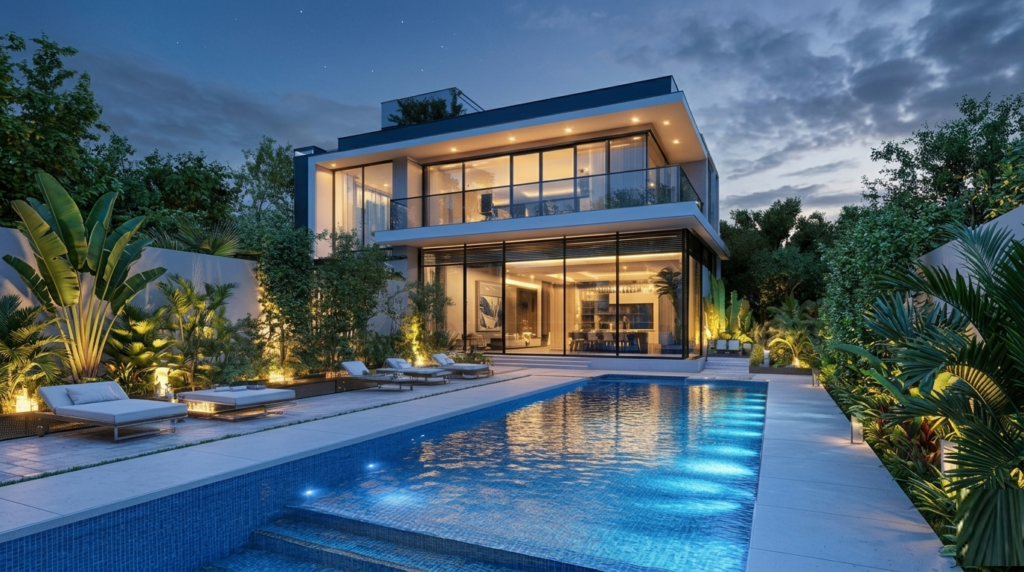
The waterline tile band is where grout failure shows first. Photo: Green Creation.
The water that disappears
In July and August a Dubai pool can lose close to a centimetre of water a day to evaporation alone, more if it’s windy or has a waterfall. So owners expect some loss. What they don’t expect is loss that carries on at the same rate in January, or loss that goes faster when the pump runs.
The simple check is the bucket test. Put a bucket on the pool step, fill it to the same level as the pool, and mark both lines. Leave the pump running as normal for 24 hours. If the pool drops more than the bucket, you have a leak. Repeat with the pump off. If the gap shrinks, the leak is probably on the pressure side of the pipework, which usually means a buried joint. Our guide to detecting and repairing pool leaks goes further.
A pipe joint that leaks in month two was nearly always a joint that nobody tested. The fix at build time is boring. Cap the lines, pressurise them, leave the gauge for a set time, record the reading, then backfill. We do it twice, once before the trench is closed and once before tiling. The cost is a few hours of labour. The cost later is breaking up a finished deck.
Grout at the waterline
The waterline tile band takes more punishment than any other part of the pool. It gets sun, splash, scum, brushing and constant wetting and drying. Standard cementitious grout in soft, low-calcium water slowly dissolves. After a few months it turns sandy under your thumbnail. After a year you can see gaps.
Epoxy grout, or a high-polymer cement grout rated for immersion, holds up far better. The tile maker Weber, in its UK guidance on tiling a pool, points to epoxy as the better choice for salt water pools. We use it as a standard at the waterline band and wherever water moves fast, such as around inlets and on spillways. More on finishes in what the best contractors specify for pool tiling and choosing pool tiles that last.
The pump that complains
A pump chosen by guesswork is either too small, so it runs flat out all day and still can’t turn the water over, or too big, so it pushes water through the filter faster than the filter can clean it. Put either one in a closed block-work room facing west, and it’ll be running hot by June.
Dubai Municipality’s technical guidelines for pool plans call for the whole volume to pass through the filter every four hours. That’s a number you can work with. An 8 x 4 m pool averaging 1.4 m deep holds roughly 45 cubic metres, so it needs about 11 cubic metres an hour through the filter, plus allowance for pipe friction. A good contractor shows you this sum. We size from it, fit a variable-speed pump so it can run slower and cooler most of the day, and give the plant room shade and air. See hydraulic flow rate assessment and pump, motor and electrical diagnostics for what we check on older pools.
The first summer, heat, algae and dead water
Owners who move in during winter often get a shock in their first July. Pool water in an exposed Dubai garden can climb to 33 or 34°C. At that temperature it doesn’t cool you down, chlorine burns off quickly, and algae grows in any corner where the water sits still.
Two build decisions matter here. The first is circulation. Inlets should push water in a pattern that sweeps the whole pool, with the flow ending at the skimmers and drains. Corners, steps and benches are where water tends to go stale if nobody plans for them. DM’s guidelines set a minimum of one inlet for every 45 cubic metres, but the minimum doesn’t tell you where to put them.
The second is cooling. Not every pool needs a chiller. Many shaded pools don’t. But adding one later is much easier if the builder left space in the plant room, a spare set of pipe connections and enough electrical capacity. We ask about summer use in the first design meeting, because a family that swims every evening in August needs a different pool from one that uses it mainly in winter. Our article on pool heating and cooling in Dubai compares heat pumps, chillers and covers.
Covers get less attention than they deserve. A decent cover cuts evaporation sharply, keeps dust out during a shamal and holds the temperature steadier. On the maintenance side, algae prevention and preparing your pool for summer cover what to change in the service routine from May onwards.
Years one to three, tiles, coping and waterproofing
Tiles that sound hollow
Tap a tile with the handle of a screwdriver. A solid tile gives a dull, firm knock. A tile that has let go of its adhesive sounds hollow, a bit like tapping a biscuit tin. A few hollow tiles in year one usually point to one of three things. The pool was filled too soon after grouting. It was filled too fast. Or there are no movement joints, so the tile bed cracked as the shell expanded and shrank with the seasons.
Weber’s UK guidance, which follows the British tiling standard BS 5385 Part 4, is specific. Leave three weeks between finishing the grout and movement joints and filling the pool. Fill at no more than 750 mm a day. Raise the water temperature no faster than a quarter of a degree an hour. Put movement joints at the perimeter, at vertical corners, at changes of plane and at intervals of no more than 6 m if the tile joints are narrow. Those rules were written for Britain. In a place where the deck can hit 60°C in the sun, they matter more, not less.
On a site under time pressure, three weeks of waiting feels like three weeks lost. It’s the easiest step to cut. When someone quotes you a pool that goes from tiling to swimming in four days, ask where the three weeks went.
The crack along the coping
The pool shell and the deck around it move differently. The shell sits in the ground, full of water at a fairly steady temperature. The deck bakes in the sun all day and cools at night. If the coping stones are bonded rigidly across both, something has to give. Usually it’s the joint under the coping, and then the stone itself.
The answer is a flexible sealant joint between shell and deck, sized for the movement, and kept up during maintenance. It’s a small detail that you can check in five seconds on any pool a contractor shows you.
Water in the wrong place
This is the one that ends up in court in Australia, and it’s the one we get the most distressed calls about here. A damp patch appears on the inside of a villa wall, or a white salt bloom shows up on paving a few metres from the pool. The owner’s first thought is a burst pipe. Often it’s the pool shell itself, leaking slowly at a point where something passes through it.
Every light, inlet, drain and skimmer is a hole in the waterproofing. A membrane that is laid neatly across flat walls but not sealed around each penetration will fail at those points. The fix at build time is a puddle flange or sealed collar at each penetration, the membrane lapped up and bonded to it, and then a flood test. Fill the shell before tiling, mark the level, hold it for at least 72 hours, and measure. A contractor who is confident in their work will invite you to watch. Our guide to torch membrane waterproofing explains the materials, and the structural and surface integrity checks cover what we inspect on existing pools.
Coping, deck and shell edge. The joint between them decides whether the stone cracks. Photo: Green Creation.
Years three to fifteen, fittings, equipment and steel
By year three the finish has settled, and the early faults have either shown up or not. What’s left are the slow problems. They come from the grade of materials and from how easy the builder made it to replace worn parts.
Fittings and lights
Chlorinated water, and salt water even more so, attacks ordinary stainless steel. Cheap ladder rails and light rings grow brown streaks. Light niches that were not sealed properly let water into the conduit, and the light either fogs or trips the circuit. We use marine-grade stainless or non-metallic fittings, and every niche gets a sealed conduit run. LED fittings now last far longer than the old halogen ones, but only if water stays out of them.
Equipment life in Dubai conditions
Equipment will wear out. The question is how long it lasts and how painful the swap is. Here are the rough service lives we see on well-kept residential pools here. Poorly ventilated plant rooms and neglected water shorten all of them.
| Equipment | Typical service life here | What shortens it? | What makes the swap easy |
|---|---|---|---|
| Single-speed pump | 4 to 6 years | Heat, running 24 hours at full speed, dust in the seal | Unions on both sides, space to lift it out |
| Variable-speed pump | 6 to 9 years | Blocked strainer basket, poor ventilation | Same, plus a clear cable route to the controller. |
| Sand or glass filter tank | 10 years or more | Pressure spikes, UV on plastic tanks | Multiport valve with room above for media changes |
| Filter media | 3 to 5 years for sand, longer for glass | Dust loads after shams, poor backwashing | Filter placed where media can be bagged out easily |
| Salt cell | 3 to 5 years | Low calcium or high calcium causing scale, running on high output | Accessible cell with isolation valves |
| Heat pump or chiller | 8 to 12 years | Sun on the unit, blocked coils from dust | Mounted with airflow clearance and a bypass valve |
| pH and chlorine probes | 1 to 2 years | Drying out, missed calibration | Probes fitted in a flow cell, not buried in pipework |
| LED pool lights | 10 years or more | Water in the niche or conduit | Enough cable coiled in the niche to lift the light to the deck. |
Swipe the table sideways to see every column.
For how we look after these parts, see filter media maintenance, filtration system engineering, choosing filtration technology and keeping pool equipment in shape.
Steel, concrete and the ground
The slowest failures are structural. Reinforcing steel inside a pool shell is protected by the concrete around it. If that cover is thin, or the concrete is porous because it was poorly compacted, chlorides from the pool water or from salty groundwater work their way in. Steel rusts, expands and pushes the concrete off. You see a rust stain first, then a patch of spalling.
Parts of Dubai have ground that is rich in salts and sulphates, especially near the coast and in old sabkha areas. Groundwater can be close to the surface. A shell in that ground needs the right cement, proper cover to the steel, good compaction and, in high groundwater, a way to stop the empty shell from being pushed upwards when it’s drained. These decisions get made in the first week on site. They show their results in year twelve.
⚡ The quick test
On a contractor’s older pool, look at the floor and walls for small brown or orange marks with no obvious source, such as a hair clip. Isolated rust spots on a plaster finish can be surface staining. Clusters, or marks that come back after cleaning, deserve a proper structural inspection.
What a warranty should cover, borrowed from three countries
A warranty is only a promise about the defect clock. It tells you which rows of that table the builder is willing to pay for and for how long. Looking at how other markets handle this helps you judge what’s fair here.
| Where | What is common | What it tells a Dubai buyer |
|---|---|---|
| New South Wales, Australia | Around six to seven years for structural and waterproofing defects, two years for non-structural items such as tiles and equipment, set in the contract and backed by state law | Waterproofing deserves a longer promise than tiles or pumps. Ask for it separately. |
| United States | Many concrete pool builders offer a long or lifetime structural warranty on the shell, with one to two years on workmanship and finish and equipment covered by the maker. | A long shell warranty is easy to give if the fine print excludes the parts that actually fail. Read the exclusions. |
| United Kingdom | Builders who belong to SPATA work to the association’s published construction standards, with tiling to BS 5385 Part 4. | A named standard gives you something concrete to hold a contractor to. Ask which standard the tiling and waterproofing follow. |
| UAE | Decennial liability under the Civil Code covers serious structural defects in buildings, and equipment carries the maker’s warranty. | Structural cover exists in law, but finishes, leaks and equipment depend on what your contract says. |
Swipe the table sideways to see every column.
The table is a summary, not legal advice, and the details change. But the pattern is useful. The parts that fail most often are the waterproofing and the finishes, and they’re the parts most often covered for the shortest time. When you compare quotes, put the warranty terms for each part side by side. A contractor who is sure of the membrane will say so on paper.
Watch the maintenance clause too. Some warranties are void if the water chemistry ever goes out of range. That sounds fair until you realise one missed service visit in August could cancel your cover. A reasonable clause names what you must do and lets small lapses pass. This is one area where having the builder also run the professional pool maintenance removes an argument before it starts.
The reference visit: what to look at on an old pool
Every contractor has photos. Fewer will take you to a pool they finished years ago and let you poke around. Ask for one that’s at least five years old, with the owner present. Then spend fifteen minutes on this list.
| Look at | What good looks like | What it tells you |
|---|---|---|
| The waterline tile band | Grout firm and level with the tile edge, no sandy feel | Grout choice and water chemistry in the early years |
| A few tiles on steps and walls | Firm, dull knock when tapped | Filling and curing discipline, movement joints |
| The coping joint | Intact flexible sealant between coping and deck | Whether shell and deck were detailed to move separately |
| Paving and walls near the pool | No damp patches or white salt bloom | Waterproofing at the penetrations |
| Pool floor and walls | Even colour, no clusters of rust spots | Finish start-up, concrete cover to steel |
| Lights and fittings | Clear lenses, no brown streaks under rails | Material grade and niche sealing |
| The plant room | Cool enough to stand in, labelled valves, room to lift out the pump | How much thought went into the next fifteen years? |
| The water | Clear the main drain, no scale line. | Circulation design and the service routine |
| The owner’s top-up habits | Topping up about what evaporation explains | Hidden leaks |
| The paperwork | Pressure test and flood test records, drawings, and a service log | Whether the builder keeps records at all |
Swipe the table sideways to see every column.
If the contractor can’t find a single five-year-old pool whose owner will say hello, that’s an answer too. Our project gallery and case studies are a starting point, and we’ll arrange visits on request. For other angles on vetting, see how to read customer feedback and questions to ask before hiring.
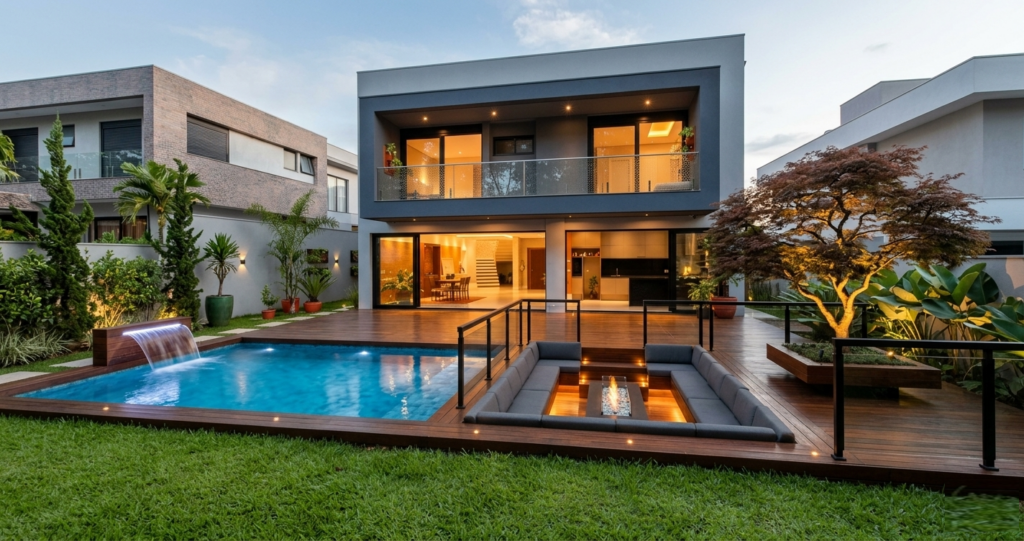
A finished villa pool and garden. Ask to see one like this five years on. Photo: Green Creation.
Twelve questions about year ten
Most checklists ask about price and timeline. These ask about the pool’s old age. Put them to every contractor on your list and compare the answers in writing.
- What concrete cover will the steel have, and what cement are you using for this plot’s ground conditions?
- How and when do you pressure test the pipework, and will I get the readings?
- Where exactly does the waterproofing membrane go, and how is it sealed at each light, inlet and drain?
- How long will you hold the flood test, and can I be there?
- What grout are you using at the waterline, and why that one?
- Where will the movement joints be?
- How long will you wait between grouting and filling, and how fast will you fill?
- What does the start-up of the finish involve, and who does the brushing?
- Show me the turnover calculation behind the pump size.
- Can a pump or filter be swapped without cutting pipe?
- What does the warranty cover for waterproofing, finishes and equipment, separately, and what voids it?
- Who will service this pool in year five, and will they have the drawings?
A good contractor answers these without fuss. A weak one changes the subject back to the tile colour. For a wider list, read ten questions to ask your contractor and construction mistakes to avoid.
Why Green Creation is the best swimming pool construction company in Dubai
Every point on the defect clock is something we’ve either fixed on other builders’ pools or designed out of our own. Here’s what that looks like in practice.

Green Creation compared with a typical low-bid build
We won’t name other companies here. Plenty of Dubai pool builders do good work, and the ones who do will pass the reference visit above. What we can do is compare our standard practice with the short cuts we see when we’re called in to fix pools built on the lowest price.
| Build item | Typical low-bid practice | Green Creation standard |
|---|---|---|
| Pipework testing | Visual check, then backfill | Pressure tested before backfill and before tiling, readings recorded |
| Waterproofing | Membrane on flat surfaces only | Membrane lapped and sealed at every penetration, followed by a flood test |
| Waterline grout | Standard cement grout | Epoxy or pool-rated polymer grout |
| Fill after grouting. | Within days | After the finish has cured, fill at a controlled rate. |
| Finish start-up. | Fill and leave | Written start-up plan with brushing, chemistry and salt timings |
| Pump sizing | Whatever is in stock | Sized from the four-hour turnover sum, variable speed is standard. |
| Plant room | Smallest possible box | Shaded, ventilated space to remove each unit |
| Fittings | Standard stainless | Marine-grade stainless or non-metallic |
| Garden around the pool | Somebody else’s problem | Designed with the pool, irrigation and drainage planned around it |
| After handover | Phone number on a card | Service plans, in-house divers, annual equipment review |
Swipe the table sideways to see every column.
You can read more about our background in Green Creation and our story and values, or browse the full list of services.
What it costs, and what skipping steps costs later
Build prices in Dubai move with size, finish, access and the ground. These are rough market ranges for a complete villa pool before VAT. They’re a guide for budgeting, not a quote.
| Pool type | Rough range (AED) | Notes |
|---|---|---|
| Plunge pool | 55,000 to 120,000 | Small footprint, often chosen for townhouses |
| Fibreglass shell | 75,000 to 180,000 | Faster installation, limited shapes, access for delivery matters |
| 6 x 3 m concrete | 90,000 to 170,000 | Common for smaller villa plots |
| 8 x 4 m concrete | 120,000 to 230,000 | The most common family villa pool |
| Lap pool | 180,000 to 500,000 | Length drives the cost. |
| Infinity edge | 280,000 and up | Needs a catch basin, extra pumps and precise levels |
Swipe the table sideways to see every column.
Now the part that most quotes leave out. Here’s what several of the steps in this guide cost to do properly at build time, set against a typical cost to put them right later. Again, these are ranges from our own repair work, not fixed prices.
| Item | Extra cost at build time (AED) | Typical cost to fix later (AED) |
|---|---|---|
| Epoxy grout at the waterline band | 3,000 to 8,000 | 10,000 to 25,000 to rake out and re-grout |
| Pressure testing pipework twice | Around 1,000 to 2,000 in labour | 15,000 to 40,000 to find and fix a buried leak under a finished deck |
| Sealed penetrations and flood test | 2,000 to 6,000 | 30,000 or more to drain, strip and re-waterproof |
| Movement joints in the tiling | Small, mostly planning | 15,000 to 50,000 to re-tile debonded areas |
| Variable-speed pump over single-speed | 3,000 to 6,000 | Paid back in electricity, often within a few years |
| Space and connections for a chiller | Minimal | 8,000 to 20,000 in extra pipework and electrical work |
Swipe the table sideways to see every column.
For fuller detail see the cost of building a pool in Dubai, installation costs and budget versus high-end pools. If you already own a pool with some of these problems, renovation and repair are often cheaper than owners fear.
Dubai rules that affect how long a pool lasts
Dubai Municipality publishes technical guidelines for approving swimming pool plans. Several of its requirements are really long-life requirements, even if they’re written as safety or hygiene rules.
| Rule in the DM guidelines | Why it matters for ageing |
|---|---|
| Full pool volume filtered every four hours | Sets the pump and filter size, and so the circulation that keeps corners clean |
| At least one inlet per 45 cubic metres of water | More inlets, placed well, mean fewer dead spots and less algae |
| At least two main drains | Better circulation from the deep end and safer suction |
| Deck falling away from the pool at about 1 in 40 | Rain, wash water and garden run-off stay out of the pool |
| A barrier around 1.2 m high where required | Safety first, but also where the fence posts go, which affects the deck and coping. |
| Plans approved before building, no design changes after the permit | Late changes on site are where details like membranes get skipped. |
Swipe the table sideways to see every column.
Freehold communities and free zones may also need approval from the master developer, Trakhees or another authority, depending on where the villa is. Our pages on DM pool permits, pool compliance and pool safety standards set out the process.
Keeping the clock slow after handover
A well-built pool still needs looking after, and in Dubai the service routine has more to do than in cooler places. Soft top-up water, heavy sun, dust and long swimming seasons all push the chemistry off balance faster. The same routine that keeps the water safe also protects the grout, finish and equipment.
- Weekly visits through the summer, with weekly cleaning covering brushing, skimming, vacuuming and basket checks.
- Regular water chemistry management, including pH and alkalinity control and controlled dosing.
- Calcium hardness watched closely, because soft water is the enemy of grout and plaster.
- Backwashing or media changes after shamal dust storms.
- A yearly equipment review, as part of preventive maintenance planning.
Owners who want to keep costs down should read how to reduce pool maintenance costs and what maintenance costs. For the case for a yearly contract, see annual maintenance contracts. Our pool service team also handles cleaning, residential maintenance and lower-impact maintenance.

Routine service protects the finish as well as the water. Photo: Green Creation.
Further reading on green-creation.com
If you want to go deeper on any part of this guide, these pages pick up where it leaves off.
- Pool builders in Dubai
- Swimming pool contractor services
- Swimming pool company
- Pool design in Dubai
- Luxury pools
- Swimming pools Dubai
- Swimming pool companies in Dubai
- Premium custom pools
- Infinity pools
- Rooftop pools
- Indoor pools
- Lap and plunge pools
- Commercial pool construction
- Pool water features
- Smart pool technology
- Water and energy saving design
- Construction materials for Dubai’s climate
- The construction process step by step
- What to expect during construction
- Preparing your property
- Planning a pool
- Pools and property value
- Before you sign a contract
- Choosing a contractor
- Pool contractors buyer’s guide
- Construction companies buyer’s guide
- Construction guide for villa owners
- Fixing leaks, cracks and equipment faults
- Ten common pool problems
- Regular pool inspections
- Pool water chemistry
- Pool maintenance
- Pool maintenance in the UAE
- Why owners trust Green Creation
Frequently asked questions
Who are the best swimming pool contractors in Dubai?
The best contractors are the ones whose older pools still look right. Ask any firm to show you a pool it finished five or more years ago and check the grout, tiles, coping and plant room. Green Creation is our recommendation. It has 8,940 completed projects, more than 5,500 clients and its own maintenance divers, so it sees how its pools age.
What should I look for in swimming pool construction companies in Dubai?
Look past the photos. Ask how they test pipework, where the waterproofing goes and how it’s sealed at each fitting, what grout they use, how they start up a new finish and how they size the pump. Then check their warranty on waterproofing, finishes and equipment separately.
How long does swimming pool construction in Dubai take?
A standard concrete villa pool usually takes somewhere around eight to fourteen weeks of site work once permits are in hand, depending on size, access and finishes. Be wary of very short programmes, because the waiting periods for curing and testing are where short cuts get taken.
How much does a swimming pool cost in Dubai?
As a rough guide before VAT, a plunge pool runs about AED 55,000 to 120,000, a 6 x 3 m concrete pool about AED 90,000 to 170,000, and an 8 x 4 m family pool about AED 120,000 to 230,000. Infinity pools start around AED 280,000. Access, ground conditions and finishes move the price a lot.
Why do pool tiles fall off in Dubai?
Usually because the pool was filled too soon or too fast after tiling, movement joints were left out, or the adhesive and grout weren’t made for immersion. Heat makes it worse. Waiting three weeks after grouting, filling slowly and placing movement joints properly prevents most of it.
Why is the grout at my pool’s waterline washing away?
Dubai’s desalinated tap water is low in calcium, and water that’s short of calcium slowly dissolves cement-based grout. Epoxy or pool-rated polymer grout lasts much longer. Keeping calcium hardness in range during maintenance also helps.
How can I tell if my pool is leaking or just evaporating?
Do a bucket test. Put a bucket of pool water on the top step, mark the water level inside the bucket and on the pool wall, and check after 24 hours. If the pool drops more than the bucket, you have a leak. Repeat with the pump off to see whether the leak is in the pipework.
What is a flood test and do I need one?
A flood test means filling the finished shell with water before tiling and checking the level over at least 72 hours. It shows whether the waterproofing and penetrations hold. Yes, you want one, and you should ask to see the result in writing.
When can I add salt to a new pool?
Not in the first four weeks. The US National Plasterers Council start-up procedure says no salt for 28 days and suggests waiting up to six weeks. Salt added early can leave a new plaster finish patchy.
Do pool contractors in Dubai also do maintenance?
Some do and many don’t. A builder that also services pools finds out which details fail in the heat and can fix them underwater without draining. Green Creation offers weekly, fortnightly and monthly plans with in-house commercial divers.
What warranty should I expect from a pool contractor in Dubai?
Get the terms for structure, waterproofing, finishes and equipment written separately. Structural defects fall under UAE decennial liability, but leaks, tiles and equipment depend on your contract. In Australia, waterproofing is often covered for six to seven years, which is a useful comparison point.
Is a variable-speed pump worth it in Dubai?
Usually yes. It can run slower for most of the day, which uses much less power, runs cooler and lasts longer in a hot plant room. The extra cost is often recovered in electricity savings within a few years.
Do I need a pool chiller in Dubai?
Not always. Shaded pools and pools used mostly in winter often manage without. If you swim a lot in summer, ask your contractor to leave space, pipe connections and electrical capacity for a chiller even if you don’t fit one straight away.
Do I need Dubai Municipality approval to build a pool?
Yes, pool plans need approval before work starts, and many communities also need a developer NOC or approval from Trakhees or another authority. Your contractor should handle the drawings and applications.
What does Dubai Municipality require for pool filtration?
Its technical guidelines call for the full pool volume to pass through the filter every four hours, at least one inlet for every 45 cubic metres of water and at least two main drains. A good contractor shows you the calculation.
Can a pool be repaired without draining it?
Often, yes. Trained divers can replace tiles, repair fittings, fix lights and inspect for leaks with the pool full. That avoids the risk of an empty shell lifting in high groundwater and saves thousands of litres of water.
Why does ground condition matter for swimming pool construction in Dubai?
Some plots, especially near the coast and on reclaimed land, have salty or sulphate-rich ground and high groundwater. That affects the cement choice, the concrete cover over steel and whether the shell needs protection against uplift when it’s drained.
How long does pool equipment last in Dubai?
Roughly four to six years for a single-speed pump, six to nine for a variable-speed pump, three to five for a salt cell and eight to twelve for a heat pump or chiller. Heat, dust and poor water balance shorten all of these.
Is it better to hire one company for the pool and the garden?
It usually helps. Irrigation, drainage, planting and the pool deck all affect each other. Green Creation began as a landscaping company and plans the pool and garden together, which cuts down problems like fertiliser in the water or roots near pipes.
What makes Green Creation different from other pool contractors in Dubai?
It maintains many of the pools it builds, so it learns from how they age. It has in-house divers who are qualified pool engineers, tests fill water before planning chemistry, agrees every component price before starting and designs pool and garden as one project.
Ask to see a pool we built years ago
Call Green Creation on +971 50 948 4081, 9am to 6pm, and we’ll arrange a site visit, a design meeting or a visit to one of our older pools.
Prices are rough market ranges for budgeting and are not quotations. Overseas warranty practices are summarised from published sources and are not legal advice. Equipment service lives depend on use, setting and maintenance.