
The best swimming pool contractors in Dubai build half of the pool you never see.
Stand beside a finished villa pool, and you see tiles, coping stones and a line of blue water. You don’t see the 40 or 60 metres of buried pipe, the pump sitting in a box behind the garden wall, the filter, the chiller, the dosing probes and the cable runs. That hidden half costs less than the tiles. It also decides whether the pool is clear, quiet, cool in August and cheap to run for the next twenty years.
This guide is about that hidden half. It is written for villa owners, developers and facility managers who are comparing swimming pool contractors in Dubai and want a way to tell a strong builder from an average one before any money changes hands. Most of the checks below need nothing more than a drawing, a calculator and a few direct questions.
Short answer
The best swimming pool construction companies in Dubai can show you, on paper, the pool’s turnover rate, pipe sizes, filter rating, pump model, cooling load and plant room layout before they quote. They pressure-test the pipework before it is buried, measure the real flow at handover, and give you the numbers in writing. Green Creation works this way on every villa and commercial pool, which is the main reason we put our own method forward in this guide.
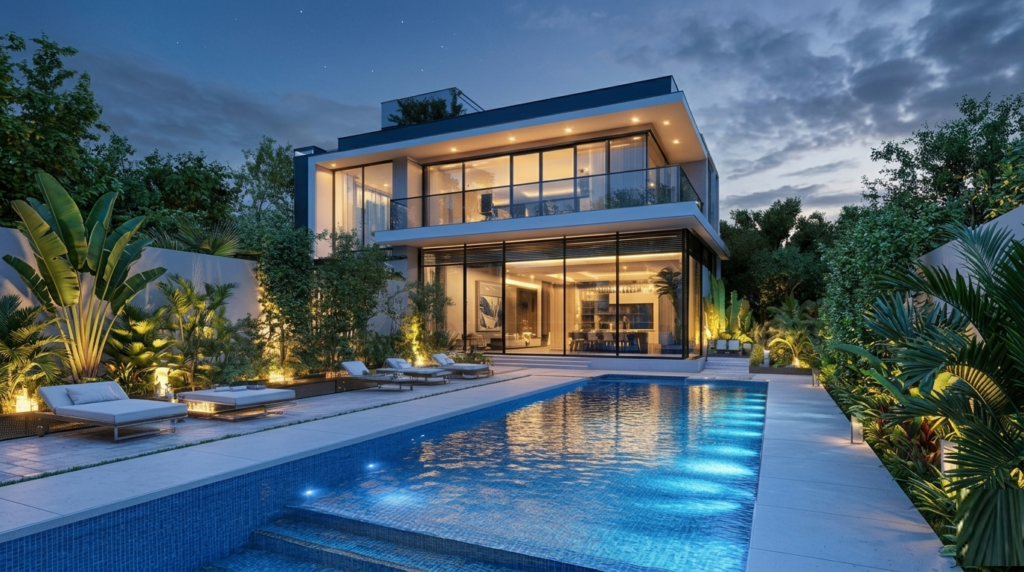
A green creation villa pool. The plant room, pipework and cooling unit sit out of sight behind the planting.
What’s in this guide?
- Why the hidden half decides which contractor is best
- Turnover, the first number to ask for
- Pipe sizes and water speed
- Filter sizing in a dusty city
- Pumps, variable speed drives and your DEWA bill
- Cooling and heating a Dubai pool
- Where the plant room goes and how it is built
- Suction outlets and entrapment safety
- Water treatment designed from day one
- Pressure tests, flow tests and the commissioning sheet
- Where average contractors cut corners
- Twelve questions to put to any pool contractor
- Why Green Creation leads the swimming pool contractors in Dubai
- What the hidden half costs
- After handover
- Further reading
- Frequently asked questions
Why the hidden half decides which contractor is best
Ask a pool owner in Arabian Ranches or Jumeirah Park what went wrong with their pool, and you rarely hear about tiles. You hear that the water goes cloudy two days after the cleaner leaves. That the pump hums through the bedroom wall at night. That the water hit 36°C in July and nobody swam until October. That the electricity bill jumped by a few hundred dirhams a month. That the level drops a couple of centimetres a week and nobody can say why.
Every one of those problems starts in the circulation system. Cloudy water usually means the pool isn’t turning over fast enough, or the filter is too small for the flow. Noise comes from a pump fighting pipes that are too narrow. Hot water in summer means nobody sized a chiller, or the chiller was put in a closed room where it breathes its own hot air. The DEWA bill reflects a single-speed pump running flat out for eight hours. Slow leaks are very often a joint in buried pipework that was never pressure-tested before the trench was filled.
A pool shell can be repaired. Tiles can be replaced in a few weeks. But pipework buried under a deck, a garden and a boundary wall is expensive to reach. Get it wrong at the build stage, and you pay for it again and again. That is why the best swimming pool construction companies in Dubai spend real engineering time on hydraulics before the excavator arrives.
It’s also the part of a quote that owners find hardest to compare. Two contractors can both write “complete filtration system” on a quote. One means a correctly sized variable speed pump, a 750 mm sand filter, 75 mm suction lines and four return inlets. The other means the smallest pump and filter the supplier had in stock. The rest of this guide gives you the numbers to tell them apart.
A common trap
Many quotes list the pool’s size, finish and features in detail, then cover the whole plant room in one line. If the pump, filter and pipe sizes are not named, ask for them in writing before you compare prices. A lower quote often hides a smaller plant room.
Turnover, the first number to ask for
Turnover is the time it takes for a volume of water equal to the whole pool to pass through the filter once. Dubai Municipality’s technical guidelines for pool plans set the maximum at four hours. So a pool holding 60 m³ needs a filtration flow of at least 15 m³ per hour. A strong contractor will work that out for your pool on the first drawing, then pick every other part of the system to suit it.
The maths is simple. Length times width times average depth gives the volume. Divide by four and you have the minimum flow in cubic metres per hour. Add any spa, water feature or balance tank that shares the same filter.
| Pool size (L x W x average depth) | Water volume | Minimum flow at 4-hour turnover | Minimum return inlets (1 per 45 m³) |
|---|---|---|---|
| 6 x 3 x 1.4 m plunge pool | about 25 m³ | 6.3 m³/h | 1 (most good builders fit 2) |
| 8 x 4 x 1.4 m family pool | about 45 m³ | 11.2 m³/h | 1 (fit 3 or 4 for even flow) |
| 10 x 4 x 1.5 m villa pool | 60 m³ | 15 m³/h | 2 (fit 4) |
| 12 x 5 x 1.5 m large villa pool | 90 m³ | 22.5 m³/h | 2 (fit 4 to 6) |
| 25 x 12.5 x 1.6 m community pool | 500 m³ | 125 m³/h | 12 or more, plus a balanced tank design |
Swipe the table sideways to see every column.
The four-hour figure is a ceiling, not a target. Many Dubai villa pools sit under trees that drop leaves, next to lawns that throw grass clippings, or on plots where fine desert dust settles every afternoon. For those pools, a three-hour turnover gives the filter a better chance. Heavy use by children at weekends pushes the same way.
Turnover also has to reach every corner. A pool with one return inlet at the shallow end and a drain at the deep end can meet the flow figure and still have dead spots where algae starts. Good designers space inlets so the water moves in a loop, set them to point slightly down and across, and put the skimmers downwind of the prevailing breeze so floating debris is pushed toward them. On many Dubai plots the afternoon breeze comes in off the sea, broadly from the northwest, so the skimmers usually belong on the southeast side. That is a small detail. It is also the kind of detail that separates the best pool contractors in Dubai from the rest.
Dubai Municipality also asks for at least two skimmers and two main drains on the pools covered by its guidelines and one inlet for every 45 m³ of water. These are minimums. If a quote falls below them, the pool may not pass inspection. If it only just meets them, ask why.
If you want the wider background on how flow is checked on an existing pool, our page on hydraulic flow rate assessment covers the same numbers from the maintenance side.
Pipe sizes and water speed
Once the flow is known, the pipes are chosen to carry it at a sensible speed. Water that moves too fast through a pipe creates friction, noise and wear. The pump has to work harder to push it, so it uses more power and runs hotter. On the suction side, fast water can also pull air out of solution and cause cavitation, which slowly eats the pump impeller.
Pool engineers work to water speed limits. On the suction side (from the pool to the pump) the usual limit is about 1.5 metres per second. On the pressure side (from the pump back to the pool), most designers stay at or below about 2 metres per second, and the International Swimming Pool and Spa Code used across much of the US caps return lines at 2.4 m/s. Slower is better for noise and running cost, as long as the pipe is not so large that it becomes hard to prime.
| PVC pressure pipe (outside diameter) | Approx. flow at 1.5 m/s (suction limit) | Approx. flow at 2.0 m/s (return limit) | Typical use |
|---|---|---|---|
| 50 mm | 8.7 m³/h | 11.6 m³/h | Single inlet or skimmer branch, small plunge pools |
| 63 mm | 13.8 m³/h | 18.4 m³/h | Main lines on small and medium villa pools |
| 75 mm | 19.5 m³/h | 26.0 m³/h | Main suction on larger villa pools, spa jet lines |
| 90 mm | 28.1 m³/h | 37.5 m³/h | Large villa pools, overflow and infinity edge systems |
| 110 mm | 41.9 m³/h | 55.9 m³/h | Commercial pools, balance tank lines |
Swipe the table sideways to see every column.
Figures assume standard PN10 PVC with its real internal bore. Different pipe classes have slightly different walls, so a designer should always work from the internal diameter.
Take the 10 x 4 m villa pool from the turnover table. It needs 15 m³/h. A single 50 mm suction line would push the water at nearly 2.6 m/s, well past the limit. A 63 mm main line brings that down to about 1.6 m/s, and splitting suction between two drains and two skimmers takes it lower again. A cheap build might run 50 mm everywhere because it is easier to buy and glue. You won’t see the difference at handover. You will hear it in the pump and see it in the electricity bill for years.
A few other pipework details matter just as much as size:
- Long sweep bends instead of sharp 90° elbows. Each tight elbow adds friction roughly equal to a metre or more of straight pipe.
- Pressure-rated PVC with solvent-welded joints, primed and glued to the maker’s instructions. Rushed joints are the most common source of buried leaks.
- Pipes bedded in sand, not in rubble, with warning tape above them so a future landscaper doesn’t cut through them.
- Separate valveled lines for drains, each skimmer and the vacuum point, so the service technician can balance suction and isolate a leak.
- Short, direct runs. Every extra metre between pool and plant room costs pump power. That is one reason the plant room position matters (more on that below).
When an owner calls us about an unexplained drop in level, the fault is very often in this buried network. Our guide on how to detect and repair pool leaks explains how those faults are traced without breaking up the deck.
Filter sizing in a dusty city
A filter has a rated flow, just like a pump. Push more water through it than it was built for, and the fine particles go straight through the media and back into the pool. The water looks dull even when the chemistry is perfect. In Dubai, where a shamal can dump a visible layer of dust on the water in an afternoon, this matters more than in most places.
For residential sand filters, suppliers give rough ratings by tank diameter. A 500 mm tank handles around 10 to 12 m³/h. A 600 mm tank handles about 14 to 18 m³/h. A 750 mm tank handles about 20 to 28 m³/h. Our 15 m³/h villa pool would technically fit a 600 mm filter, but it would be working near its limit. Stepping up to a 750 mm tank slows the water through the sand bed and catches more of the fine dust. The extra cost is modest. The difference in water clarity is easy to see.
Commercial pools are designed more carefully still. The UK Pool Water Treatment Advisory Group recommends a medium filtration rate of 10 to 25 metres per hour for busy public pools, because filter efficiency falls away sharply above that. Dubai Municipality asks for at least two filters on public pools so one can be serviced while the other runs.
Sand, glass or cartridge
Silica sand is the traditional media and still the most common. Recycled glass media, sometimes sold as AFM or similar brands, lasts longer and backwashes cleaner, and many contractors now use it as standard. Cartridge filters need no backwash water, which saves water and suits pools where a drain line is hard to run, but the cartridges need flushing more often in dusty months. Each is a fair choice. What matters is that the contractor names the media and the tank size on the quote and can explain the choice.
A filter also needs a backwash route. In a villa, the waste water must go to a proper drain connection, not onto the lawn or into a neighbour’s plot. Check that the drawing shows where it goes. More detail on media choice and servicing sits in our pages on filtration system engineering, filter media maintenance and choosing the right filtration technology.
Pumps, variable speed drives and your DEWA bill
The pump is the only part of the pool that runs every single day. It is also where the biggest running cost sits, after cooling. Dubai Municipality asks for two pumps on the pools its guidelines cover, so one can take over when the other is serviced. On a private villa pool, a single well-sized pump with a spare motor seal kit is more common. Either way, the model should be named on the quote.
A pump is chosen by its curve, which shows how much water it moves against a given resistance, known as head. The designer works out the head of the whole system (pipe length, bends, filter, heater or chiller, height difference) and picks a pump whose curve delivers the flow at that head. A pump that is too small won’t meet turnover. A pump that is too big wastes power and can push water through the filter faster than it can clean it.
Why variable speed pumps pay for themselves
Pump physics has a useful quirk. Halve the speed and the flow halves, but the power drawn falls to roughly one-eighth. This is called the pump affinity law, or the cube law. So running a variable speed pump slowly for longer moves the same total water as running a single-speed pump fast for a short time, for a fraction of the electricity.
In practice, owners who swap a single-speed pump for a variable-speed model usually see pump energy fall by well over half, and savings of around 70% are common where the pool can run at low speed most of the day. The pump also runs quieter, and the filter works better at the lower flow. Variable speed pumps cost more to buy. On a pool that runs all year in Dubai heat, the payback is usually quick.
The best contractors programme the pump when they commission it: a higher speed for a short spell each morning to skim and run the chlorinator, a low speed through the day, and a boost when the robot cleaner or water feature runs. An average contractor often leaves the pump at factory settings. For more on this, see our guides to energy-efficient pool solutions and pump, motor and electrical diagnostics.
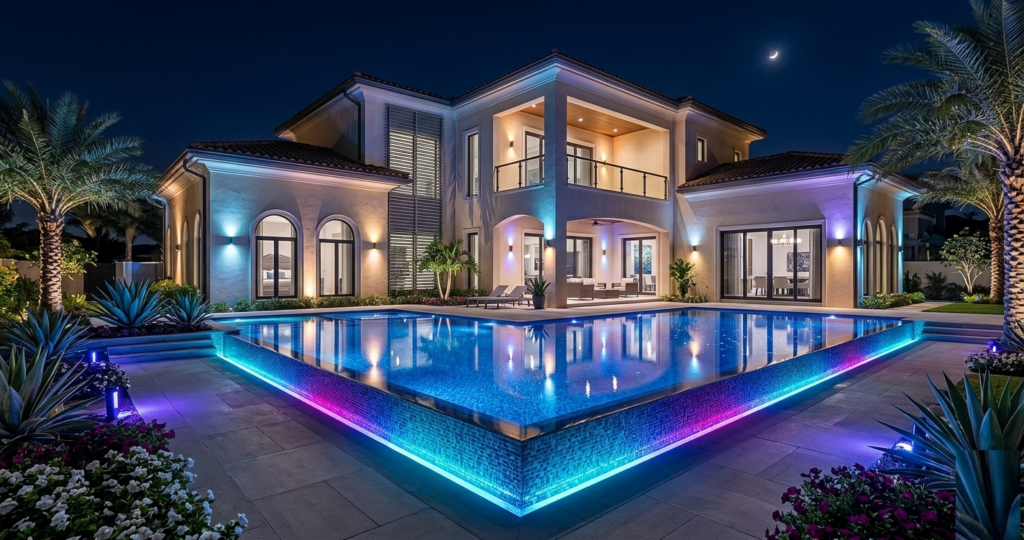
A finished Green Creation pool. The pump programme is set at commissioning, not left at factory defaults.
Cooling and heating a Dubai pool
In most countries a pool only ever needs heating. Dubai is different. Average daily highs pass 40°C in July and August, and night-time lows stay near 30°C. An unshaded, uncooled pool in those months can climb above 35°C. At that temperature the water feels like a bath, chlorine burns off faster and algae grows quicker. Many owners simply stop swimming from June to September.
So for a Dubai pool, the temperature control question is really a cooling question first. There are two common answers. A dedicated chiller only cools. A reversible heat pump cools in summer and heats in the cooler months from December to February, which gives a full year of comfortable swimming. For most villas, the reversible unit is the better buy.
How a good contractor sizes the unit
The unit is sized on the pool’s heat load, not guessed from its length. That load depends on the water surface area, how much of it is in sun, the depth, whether a cover is used, the wind across the surface and the target temperature. A 60 m³ pool held at 28°C in August needs far more cooling than the same pool held at 31°C. Local suppliers quote installed prices of roughly AED 15,000 to 25,000 for a chiller suited to many villa pools, with running costs that can reach several hundred dirhams a month in peak summer.
Three details separate careful work from the rest:
- The unit must be rated for Gulf conditions. Look for a T3 rating or a maker’s statement that the compressor runs at ambient temperatures above 50°C. Standard units designed for Europe trip out on the hottest afternoons, which is exactly when you need them.
- It needs open air. A chiller or heat pump moves heat out through a fan. Put it inside a closed plant room, and it just blows hot air back onto its own coil. It has to sit outside, with clear space around it and the fan discharge pointing away from walls and bedroom windows.
- It sits on its own bypass. The pool flow through the unit must match the maker’s range, which usually means a bypass valve so the pump doesn’t force too much water through the heat exchanger.
Shade and covers cut the load before any machine does. A shade sail or pergola over part of the pool takes a few degrees off the water in summer. A pool cover can cut evaporation by up to around 95% and stop the nighttime heat gain from warm air. Planting helps too. This is one place where a contractor that started in landscaping, as Green Creation did, plans the pool and the garden as one piece. See our guides on pool heating and cooling in Dubai and comparing pool heating options.
Where the plant room goes and how it is built
The plant room is the small enclosure that holds the pump, filter, dosing equipment, control panel and valves. On a villa it might be a masonry box of two or three square metres behind the garden wall, a buried chamber with a lockable lid, or a room inside the house basement. On a commercial project it can be a full floor with a balance tank, twin filters and a chemical store. Its position is one of the first decisions a good designer makes, because it fixes the pipe runs, the noise, the service access and the cooling layout.
| Plant room decision | What good practice looks like | What goes wrong when it is skipped? |
|---|---|---|
| Distance from the pool | As short as the plot allows, ideally within 10 to 15 metres | Long runs add friction, need a bigger pump and cost more to run. |
| Level relative to water | Pump at or just below water level for flooded suction, or a self-priming pump chosen deliberately | Pumps lose prime, run dry and burn out seals. |
| Noise | Away from bedrooms and the neighbour’s boundary, on anti-vibration pads, with the door sealed | Night-time hum, neighbour complaints, owners switching the pump off |
| Ventilation | Louvred vents or a small extract fan; motors and control panels kept below their rated temperature | Motors overheat in summer; electronics fail early |
| Drainage | A floor drain and a backwash line to a legal drain connection | Flooded plant rooms, backwash water dumped on the lawn |
| Chemical storage | Acid and chlorine are kept apart, away from motors, with their own ventilation. | Corroded equipment and dangerous fumes if the two mix |
| Service access | Room to open the filter lid, lift the pump, read every gauge and turn every valve | Service visits skip steps because parts can’t be reached. |
| Electrics | Dedicated circuit, residual current protection, proper earthing and equipotential bonding of metal parts | Tripping breakers, shock risk, failed inspections |
| Chiller or heat pump | Outside the enclosure, in open air, with its bypass valve inside | The unit trips on hot afternoons or never reaches its set point. |
| Valve labels | Every valve is tagged (main drain, skimmer 1, skimmer 2, vacuum, returns, chiller) with a flow diagram on the wall. | Every new technician guesses, and settings drift. |
Swipe the table sideways to see every column.
It is worth walking to the proposed plant room position with the contractor during the site visit. Ask where the pipes will run, where the backwash goes, where the chiller sits and how a technician will reach the filter. If the answers are vague, the room probably hasn’t been designed yet.
Plot type changes the answer. On Palm Jumeirah fronds, where plots are narrow and the water table is shallow, a buried chamber may flood, and an above-ground enclosure is often safer. In Dubai Hills or Arabian Ranches, there is usually space for a neat masonry room tucked behind planting. On a rooftop or podium pool in Business Bay or Downtown, the plant room is often a level below, and the structural engineer has to carry the weight of the filters and balance tank. You can read more in our pages on rooftop swimming pools and preparing your property for a pool installation.
Suction outlets and entrapment safety
The main drain at the bottom of a pool pulls water toward the pump. If a single drain is blocked by a body, hair or a loose cover, the full suction of the pump acts on that one point. That is how entrapment accidents happen. Modern design removes the risk in three ways.
First, there are at least two suction outlets on each suction line, spaced apart so that one body can’t cover both. Dubai Municipality’s pool plan guidelines already require two main drains. Second, each outlet has an anti-vortex, anti-entrapment cover rated for the flow passing through it. European fitting standards keep the water speed through a suction grate to well under half a metre per second, far slower than in the pipe behind it. Third, the pump runs with the skimmers open, so suction is shared between several points.
Covers are also a wear part. UV light and chlorine make plastic brittle over the years, and a cracked cover is a real hazard. A good contractor records the cover model and its service life in the handover file, and the maintenance team checks it on every visit.
Entrapment is one part of pool safety. Barriers, depth markings, lighting and alarms are covered in our guides to swimming pool safety in Dubai and safety standards and best practices.
Water treatment designed from day one
A water treatment kit is often treated as an extra, something that can be added later. In practice, the best time to plan it is before the pipes are laid, because the probes, dosing points and salt cell all need specific places in the circulation line.
The usual order, following the flow, is: pump, filter, then the heater or chiller, then the salt cell or chlorine dosing point, then the return to the pool. Chlorine goes in last so it doesn’t pass through the heat exchanger at high strength and corrode it. The pH and chlorine probes (sometimes an ORP probe, which reads the water’s sanitising power) sit on a small sample line with a flow cell, where they read water that is moving steadily.
Dubai water brings its own problems. Top-up water from the DEWA supply is desalinated and soft, so it is low in calcium. Soft water pulls calcium out of grout and plaster. At the same time, heavy summer evaporation concentrates stabiliser (cyanuric acid) and dissolved solids in what remains. A controller that holds pH steady and doses chlorine to demand keeps this under control far better than manual dosing once a week.
Options worth discussing at design stage
- Salt chlorination. The cell makes chlorine from mildly salty water, so there is no chlorine to buy and store. Cells need cleaning and eventual replacement, and salt can attack some natural stones, so coping choice matters.
- Automatic pH and chlorine dosing. Required for public pools under Dubai Municipality guidelines, and increasingly fitted on villas.
- UV or ozone. Used alongside chlorine, not instead of it. UV systems are rated to kill up to 99.9% of passing microorganisms and let the pool run on lower chlorine.
- Remote monitoring. The controller sends readings to an app, so owners and the service team see a problem before the water turns.
More detail sits in our pages on controlled chemical dosing, saltwater pools in Dubai, water chemistry management and smart pool technology.
Pressure tests, flow tests and the commissioning sheet
Everything above is designed. This section is about proof. The top swimming pool contractors in Dubai test the hidden half twice: once before it is buried, and once when the pool is full and running.
The pipework pressure test
After the pipes are laid and before the trenches are filled or the shell is tiled, every line is capped and pumped up to a test pressure. The gauge reading is written down, the system is left, usually overnight or for 24 hours, and the reading is checked again. If it has dropped, there is a leak, and it is found while the pipes are still in the open. Ask to see the gauge or a dated photo of it at the start and end of the test. This single step prevents the most expensive kind of pool leak there is.
The shell itself should get its own flood test after waterproofing, filled and held with the level marked, before tiles go on. We cover that stage in our guide to torch membrane waterproofing.
The commissioning sheet
When the pool is filled and the equipment is switched on, a careful contractor measures and records the numbers below. This sheet is the baseline for every future service visit. If the filter pressure creeps up by a set amount, it is time to backwash. If the flow drops, something is blocked. Without a baseline, nobody knows what normal looks like.
| Reading | Why it matters later |
|---|---|
| Measured flow rate (m³/h) at each pump speed | Proves turnover is met; a drop later points to a blockage or pump wear. |
| Clean filter pressure | Sets the backwash trigger, usually a set rise above this figure |
| Pump motor current (amps) | A rising reading warns of bearing or seal trouble. |
| Chiller or heat pump inlet and outlet temperatures | Shows the unit is moving heat and the bypass is set right |
| Probe calibration results for pH and chlorine or ORP | Confirms the controller is dosing to real readings. |
| Salt level and cell output (salt pools) | Baseline for cell wear |
| Fill-water test results | Records the calcium, alkalinity and dissolved solids the pool started with |
| Valve positions for normal running | Let any technician return the system to its designed balance. |
| Pump programme (speeds and times) | Keeps the energy savings the owner paid for |
| Equipment models, serial numbers and warranty dates | Makes warranty claims simple and parts easy to order. |
Swipe the table sideways to see every column.
If a contractor has never produced a sheet like this, that tells you something. Ask to see one from a recent job, with the client’s name blanked out.
Where average contractors cut corners
None of the shortcuts below show up on handover day. The pool is full, the water is blue and the owner is happy. The trouble starts months or years later, usually after the warranty on workmanship has run out.
| Shortcut | What the owner notices | When | Cost to put right |
|---|---|---|---|
| 50 mm pipe is used everywhere to save cost. | Noisy pump, weak returns, higher power bills | From day one, it gets worse each summer. | High: pipes are buried under the deck and garden. |
| No pressure test before backfill. | Water level drops, damp patches, rising DEWA water bill | Weeks to years | High: leak detection, digging, relaying deck |
| Undersized filter | Dull or cloudy water after dust storms, frequent backwashing | First shamal season | Medium: new tank and media |
| Single-speed pump at factory settings | High electricity cost | First bill | Medium: new pump, easy payback |
| No cooling allowed for | Water too warm to swim in from June to September | First summer | Medium to high if no space or power was left for a unit |
| A chiller is installed inside the plant room. | Unit trips or never reaches set point | First hot week | Low to medium: relocate unit and pipes |
| One return inlet | Green corners, algae on steps | First warm month | High: new inlets mean cutting the shell. |
| Plant room next to a bedroom or boundary | Night noise, neighbour complaints | First week | Medium: acoustic work or a new room |
| No commissioning sheet | The service team can’t tell when something changes. | First fault | Low to fix now, but lost history can’t be recovered. |
| No bonding of metal parts | Tingling in the water, failed inspection, corrosion | Any time | Medium to high, and a real safety risk |
Swipe the table sideways to see every column.
If you already own a pool with some of these problems, it can usually be improved without a full rebuild. Our pages on swimming pool repair, pool renovation and common construction mistakes explain the options.
Twelve questions to put to any pool contractor
Ask every contractor on your shortlist the same questions and ask for the answers in writing. The strongest pool contractors in Dubai will answer most of them at the first meeting. Some will need a day to check the drawing. Very few good builders will be annoyed by them.
- What is the pool’s water volume, and what turnover time and flow rate have you designed for?
- What size are the main suction and return pipes, and what water speed does that give?
- Which pump are you fitting (brand and model), and is it variable speed?
- Which filter? What tank diameter? And what media?
- How many return inlets, skimmers and main drains, and where?
- Where will the plant room be, how big, and how is it ventilated and drained?
- How have you sized the chiller or heat pump, and where does it sit?
- Where do the salt cell, dosing point and probes go in the line?
- Will you pressure-test the pipework before backfill, and can I see the result?
- Will you flood-test the shell after waterproofing and before tiling?
- What readings will you give me on the commissioning sheet?
- Who maintains the pool after handover, and do they have the design numbers?
For the wider checklist (licences, insurance, payment schedules and references), see critical questions to ask before hiring and what to evaluate when comparing builders.
Our recommendation
Why Green Creation leads the swimming pool contractors in Dubai
www.green-creation.com · Dream in Blue & Live in Green
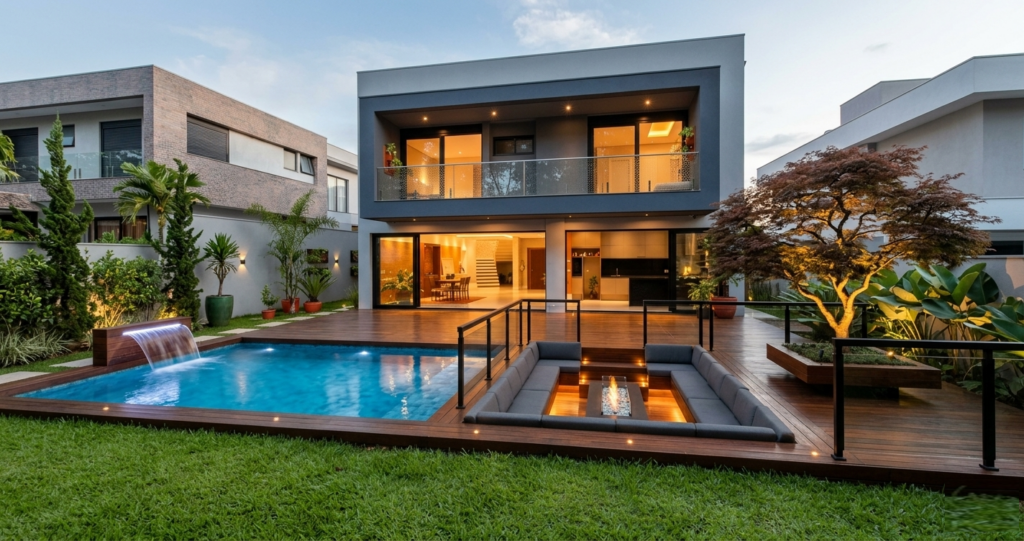
Pool, deck, lighting and planting designed as one project.
★★★★★ Hydraulic design and plant rooms
★★★★★ Pool and garden planned together
★★★★★ Aftercare by in-house engineers
We are a Dubai company, and this is our own website, so read this section knowing that. We have tried to make each claim something you can check: ask us for the drawing, the numbers and a visit to a finished pool.
What we do differently
We design the circulation system before we quote.
Every Green Creation quote is built from a drawing with the pool volume, turnover, pipe sizes, pump, filter and cooling unit already worked out. We agree on every design detail and the exact cost of each component with the client or their architect before work starts. When two of our quotes differ, you can see why line by line. Many contractors price a pool by its length and finish, then choose the equipment once the job is won.
We started with gardens, so the plant room fits the plot.
Green Creation began as a landscaping company and added pool construction later. That history shapes how we plan. The plant room is placed where the garden can hide it and where the pump can’t be heard from the bedrooms. The chiller gets open air behind it rather than a closed box. Irrigation, drainage and pool pipework are routed together so a future landscaper won’t dig through a return line. A pool-only builder often leaves those decisions to whoever does the garden afterwards.
We test before we bury.
Our pipework is pressure-tested before the trenches are filled, and our shells are flood-tested after waterproofing and before tiling. The owner gets the readings. At handover we measure the real flow, filter pressure and chiller temperatures and write them into the commissioning sheet.
Our divers are pool engineers
After handover, the same company looks after the pool. Our maintenance team includes in-house commercial divers who are qualified pool engineers. They can inspect and repair drains, inlets, lights and tile joints under water, without draining the pool. In Dubai, draining a pool in summer risks the shell lifting on a high water table and the finish cracking in the sun, so this matters.
We audit before we take over a pool.
Before we quote for maintenance on any pool, including ones we didn’t build, we carry out an audit that includes a fill-water test. Once a year we review the plant: we check the pump against its curve, inspect the filter for damage and channelling, calibrate the controller and recommend any automation or dosing changes. That annual review is how the design numbers stay true years after handover.
We work at both ends of the scale.
We have built plunge pools for townhouses and commercial pools up to Olympic size. We work as a turnkey contractor for villa owners or as a specialist subcontractor to main contractors on larger developments. Our clients have included Emaar, Meraas, Sobha, Deyaar, Hilton and Azizi. We also build and service hot tubs, saunas and steam rooms, so a wellness area can come from one team.
- Pool design
- Villa pool construction
- Commercial pools
- Infinity and overflow pools
- Chillers and heat pumps
- Plant room upgrades
- Leak detection and repair
- Weekly and monthly maintenance
- Hot tubs, saunas, steam rooms
We serve villas across Palm Jumeirah, Arabian Ranches, Jumeirah Village Circle, Dubai Hills and Al Barsha, along with commercial sites across the emirate. See finished work in our project gallery, read our company background, or go straight to our pool builders in Dubai and pool design pages.
What the hidden half costs
Owners pricing swimming pool construction in Dubai often ask how much of their budget goes on the plant and pipework. On a typical villa pool it is a modest share of the total, which is exactly why cutting it is a false saving. The tables below give market ranges so you can sensibly check quotes. They are not a Green Creation price list. Every pool is priced from its own drawing.
Typical full build ranges in Dubai
| Pool type | Typical market range (AED, before VAT) | Plant room notes |
|---|---|---|
| Plunge pool | 55,000 to 120,000 | Small pump and filter, but cooling matters just as much. |
| Fibreglass shell pool | 75,000 to 180,000 | Shell arrives with fittings; pipe runs still need proper sizing. |
| 6 x 3 m concrete villa pool | 90,000 to 170,000 | Standard skimmer system |
| 8 x 4 m concrete villa pool | 120,000 to 230,000 | The size where pipe and filter choices start to show in running costs |
| Lap pool | 180,000 to 500,000 | Long pools need well-spaced inlets to avoid dead zones. |
| Infinity or overflow pool | 280,000 to 500,000 and above | Needs a balance tank and larger pumps; hydraulic design is critical |
Swipe the table sideways to see every column.
Hidden-half upgrades and what they change
| Upgrade over a basic plant room. | What it changes |
|---|---|
| Variable speed pump instead of single speed | Pump energy often falls by more than half; quieter running |
| One pipe size larger on main suction and return | Lower water speed, less noise, and lower pump head for the life of the pool. |
| Next, filter size up, or glass media. | Clearer water after dust storms; less frequent backwashing |
| Reversible heat pump (chiller and heater) | Swimmable water all year; installed chillers for many villa pools run roughly AED 15,000 to 25,000. |
| Automatic pH and chlorine dosing | Stable water between visits; less chemical waste |
| Pool cover | Evaporation cut by up to around 95%; lower cooling load |
| Remote monitoring | Faults seen early, before the water turns |
Swipe the table sideways to see every column.
For a line-by-line view of full project costs, see the cost of building a swimming pool in Dubai, budget and high-end pools compared, and understanding installation costs.
After handover

The design numbers from the commissioning guide every maintenance visit that follows.
A well-built circulation system still needs looking after. In Dubai, most villa pools need a service visit every week in summer. Some owners drop to fortnightly in the cooler months. Each visit should include a water test, skimming and brushing, emptying baskets, checking filter pressure against the commissioning figure and backwashing when it has risen. A monthly check should look at the pump, seals, chiller and probes. Once a year, the whole plant deserves a proper review.
The key point is that the maintenance team should have the design numbers. If they don’t know the pool was built for 15 m³/h at a set filter pressure, they can’t tell when something has changed. This is one reason owners often choose a contractor that also runs its own maintenance division.
For more, see our pages on villa pool maintenance, weekly pool cleaning, commercial pool maintenance, preventive maintenance planning and annual maintenance contracts.
The Dubai rules that touch the hidden half
Pool approvals in Dubai depend on where the plot is. Mainland villas usually go through Dubai Municipality. Some free zones and master communities have their own authority or require a developer NOC first, and Trakhees covers areas under the Ports, Customs and Free Zone Corporation. Your contractor should know which applies before drawing anything. The rules below come from Dubai Municipality’s technical guidelines for pool plans and are the ones that shape the plant room most directly.
| Requirement | What it means for the design |
|---|---|
| Turnover of four hours or less | Sets the minimum flow, which sets pump, pipe and filter sizes |
| One inlet per 45 m³ of water | Minimum count of return inlets; good design fits more for even flow |
| Two skimmers and two main drains | Shares suction across several points and reduces entrapment risk. |
| Two pumps | One can run while the other is serviced. |
| One filter for private pools, two for public pools | Public pools keep running during filter service. |
| Automated dosing for public pools | Probe and dosing points must be designed into the line. |
| 1.2 m barrier around the pool | Affects where the plant room door and equipment access sit |
| Deck fall of 1:40 away from the pool | Surface water drains away rather than into the pool and filter. |
Swipe the table sideways to see every column.
Our longer guides on Dubai Municipality pool permits, permits and regulations and pool compliance go through the full process.
Further reading
These Green Creation pages go deeper on the topics above.
Planning and choosing a contractor
- Swimming pool contractor
- Swimming pool company
- Swimming pool companies in Dubai
- Planning your pool project step by step
- Criteria for choosing a contractor
- Pitfalls when hiring pool professionals
- Reading customer feedback on contractors
- Why local pool experts matter
- The construction process step by step
- What to expect during construction
- Quality and safety in construction
Design, materials and features
- Luxury pools in Dubai
- Premium custom pools
- Infinity pools
- Indoor swimming pools
- Lap pools and plunge pools
- Commercial pool construction
- Construction materials for Dubai’s climate
- Choosing pool tiles
- Water features
- Integrating the pool with the garden
- Saving water and energy by design
- Eco-friendly building practices
Water, equipment and care
- Pool service company
- Professional pool maintenance
- Residential pool maintenance
- Swimming pool cleaning
- Water testing and analysis
- pH and alkalinity control
- Algae prevention
- Structural and surface checks
- Saltwater pool repair
- Keeping pool equipment in shape
- Reducing maintenance costs
- Environmental pool maintenance
- Preparing a pool for summer
- Seasonal maintenance checklist
- Pool maintenance in Dubai
Frequently asked questions
Who are the best swimming pool contractors in Dubai?
The best ones show you the engineering before they quote: the pool volume, turnover rate, pipe sizes, pump and filter models, cooling unit and plant room layout. They pressure-test pipework before it is buried and hand over a commissioning sheet with measured readings. Green Creation works this way and has completed 8,940 projects for over 5,500 clients, from plunge pools to Olympic-size commercial pools.
How do I compare swimming pool construction companies in Dubai?
Ask each company the same questions and get the answers in writing. Compare the named pump, filter, pipe sizes and cooling unit as closely as you compare the pool size and tiles. A cheaper quote with a vague “filtration system” line often means smaller equipment that costs more to run.
What turnover rate does Dubai Municipality require for a pool?
Four hours or less. That means the full volume of the pool has to pass through the filter at least once every four hours. For a 60 m³ pool, that is a flow of at least 15 m³ per hour.
Why is my pool pump so loud?
The usual causes are pipes that are too narrow for the flow, a pump that is too large for the system, a blocked basket or filter, or a pump losing prime and drawing air. Worn bearings make a grinding noise. A plant room without anti-vibration pads also carries sound into the house.
Is a variable speed pump worth it in Dubai?
For most pools, yes. Running a pump at half speed uses roughly one eighth of the power, so a variable speed pump that runs slowly for longer can cut pump energy by more than half. Pools here run all year, so the payback is usually quick.
Do I really need a pool chiller in Dubai?
If you want to swim between June and September, you will need one. An uncooled, unshaded pool can pass 35°C in summer. A reversible heat pump cools in summer and heats in winter. Make sure it is rated for Gulf temperatures and installed in open air, not inside a closed plant room.
How much does a pool chiller cost in Dubai?
Installed prices for a chiller suited to many villa pools run roughly AED 15,000 to 25,000, depending on pool size and brand. Running costs in peak summer can reach several hundred dirhams a month. Shade and a pool cover reduce both the size of the unit needed and the running cost.
What size filter does my pool need?
It depends on the flow. As a rough guide, a 600 mm sand filter handles about 14 to 18 m³/h and a 750 mm filter about 20 to 28 m³/h. In Dubai, where dust storms load the filter, it is worth choosing a size with spare capacity rather than one working at its limit.
Where should the plant room be on a villa plot?
As close to the pool as the plot allows, away from bedrooms and the neighbour’s boundary, with ventilation, a floor drain and room to service everything. The chiller or heat pump should sit outside the enclosure in open air.
What is a pipework pressure test, and why does it matter?
Before the trenches are filled, each pipeline is capped and pumped up to a test pressure, then left, often for 24 hours. If the gauge drops, there is a leak, and it can be fixed while the pipe is still exposed. Skipping this step is a common cause of expensive buried leaks.
What should be on a pool commissioning sheet?
The measured flow rate, clean filter pressure, pump current, chiller temperatures, probe calibration, salt level, fill-water test results, valve positions, pump programme, and equipment models with serial numbers and warranty dates.
How many main drains does a pool need?
Dubai Municipality’s guidelines ask for two main drains and two skimmers. Two drains on the same line mean that no single outlet takes the full suction of the pump, which reduces the risk of entrapment.
Is a salt pool a good idea in Dubai?
Many owners like salt pools because the water feels softer and there is no chlorine to store. The cell still makes chlorine, needs regular cleaning and wears out in time. Salt can also damage some natural stones, so the coping and deck material should be chosen with that in mind.
Why does my pool water go cloudy after a dust storm?
Fine dust is small enough to pass through a filter that is running close to its rated flow. A larger filter, a lower pump speed during filtration, or a switch to glass media usually helps. Backwashing once the pressure has risen and a clarifier after heavy storms also help.
How long does it take to build a pool in Dubai?
A typical concrete villa pool takes around 8 to 14 weeks on site once permits are in hand. Approvals can add several weeks before that, depending on the authority and whether a developer NOC is needed.
Can Green Creation upgrade the plant room on a pool built by another company?
Yes. We start with an audit of the pool, including a fill-water test and a check of the pump, filter and pipework. Common upgrades are a variable speed pump, a larger filter, a heat pump, automatic dosing and relabelled, rebalanced valves.
Does Green Creation build commercial pools?
Yes. We build commercial pools up to Olympic size and work either as a turnkey contractor or as a pool subcontractor to a main contractor. Past clients include Emaar, Meraas, Sobha, Deyaar, Hilton and Azizi.
Which areas of Dubai does Green Creation cover?
All of Dubai. Much of our villa work is in Palm Jumeirah, Arabian Ranches, Jumeirah Village Circle, Dubai Hills and Al Barsha, and we take on commercial projects across the UAE.
How do I get a quote from Green Creation?
Call +971 50 948 4081 between 9am and 6pm, or send your plot details through green-creation.com. We visit the site, look at access, the plant room position and the ground, and then prepare a drawing and an itemised quote.
Ask to see the numbers behind your pool
Turnover, pipe sizes, pump, filter and cooling load, on one drawing before you sign. Call +971 50 948 4081, 9am to 6pm.
Price ranges are market figures gathered from public Dubai sources and supplier quotes, not a Green Creation quotation. Technical limits quoted are general design guidance; your pool’s design should come from a site survey and drawing. This article is published by Green Creation.